Crickets
Rear WindowCrickets are both an audible presence in the back yards and a sign of death in Sam’s folk belief. Their chirping recurs during Hal Jeffries’s sleepless watch, first as a sound Sam interprets and later as a reminder Hal cannot entirely set aside. The story never establishes that the omen is literally fulfilled; instead, the Crickets turn ordinary night sounds into a source of foreboding and sharpen the gap between what Hal sees and what he understands.
Appearance and Reported Significance
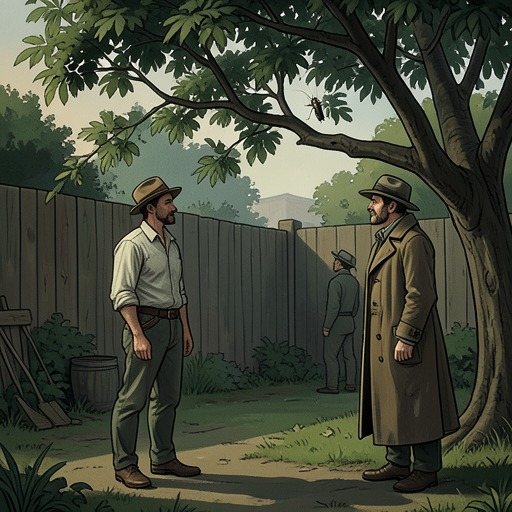
The Crickets enter the account through sound rather than sight. During a pause in the night, one chirps in a back yard while Sam, who has come to see whether Hal wants anything before he goes home, stands with his head lowered. He shakes it slightly, as though troubled by something, and Hal asks what is wrong. Sam explains that his mother taught him to regard a cricket’s call as a sign of death nearby. He claims the warning has never failed him. The belief is presented as Sam’s inherited certainty, not as an independently verified rule of the story’s world.
Hal answers by brushing the concern aside: the sound is not inside the apartment, so Sam should not worry. Sam leaves still insisting that death must be somewhere close. His departure gives the superstition a small but definite dramatic force: what Hal treats as a harmless sound becomes, for Sam, a warning that cannot be confined to the room where it is heard. The exchange also establishes a contrast between Hal’s skeptical response and Sam’s conviction without resolving which attitude is justified.
The First Night
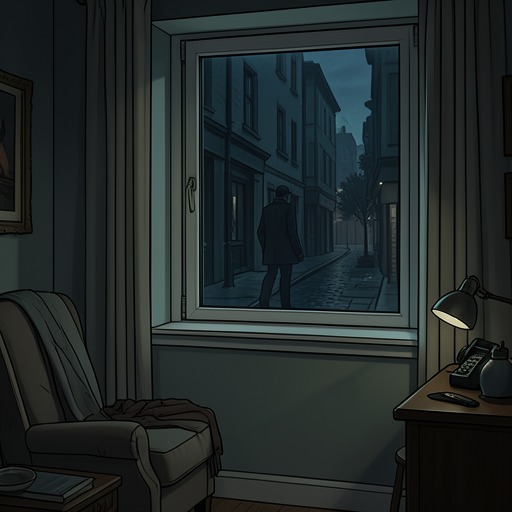
After Sam leaves, Hal remains alone in the dark. The night is stifling, and even the open window offers little relief. The solitary chirp belongs to a setting where Hal is already watching another darkened room across the way, trying to make sense of what its occupant is doing. Against that visual scrutiny, the Crickets provide an intermittent sound that cannot explain what Hal sees but keeps the surrounding quiet from feeling empty.
The sound persists while the night offers no answer. Hal’s attention moves between the unseen activity beyond the windows and the familiar chirping in the yards; the two remain distinct, but their juxtaposition makes the ordinary neighborhood seem charged with possible danger. At morning’s first light Hal is back at the window, exhausted by the heat and lack of sleep. Sam finds him there and remarks on how worn out he looks. The Crickets’ first appearance thus belongs to a night that carries into morning without settling the questions that kept Hal awake.
Recurrence and Delayed Recognition
Later, after a sequence of looks, darkness, and a brief flicker of light across the houses, Hal describes his own understanding as delayed: his eyes have registered what happened before his mind has made sense of it. In the stillness that follows, the spaced clicking of a cricket begins again. The sound brings Sam’s claim back to Hal’s mind, and the omen now seems troubling for somebody in the surrounding houses. The earlier exchange has changed the force of the sound: Hal had brushed it away when Sam voiced the superstition, but in this moment he remembers it as a possible warning.
The timing matters. The cricket’s return does not explain the ambiguous looks or establish what they mean. Instead, it arrives after Hal has noticed them and before he has settled on an interpretation. Its familiar click gives shape to his unease while leaving its cause uncertain. In this way the Crickets accompany the story’s pattern of delayed recognition: details can be plainly perceived and still resist an immediate, reliable explanation.
Sound, Misinterpretation, and Omen
Only about ten minutes have passed since Sam went away when Hal hears faint jiggling at the building’s front-door lock. He supposes Sam has returned for something forgotten, perhaps a hat or a key, and imagines that drink may have made his hand less steady. Hal also reasons from familiar habits: Sam does not smoke, would be unlikely to have a match to find the keyhole, and usually lets doors swing shut noisily. The sounds stop without the expected door-slam, leaving Hal to conclude that Sam has given up and gone away again.
The cricket’s clicking and the lock’s faint movement are separate sounds, but their sequence binds them in Hal’s attention. The folk warning has made death feel close; the unexplained noise then invites an everyday explanation involving Sam. That explanation is Hal’s assumption, not confirmation that Sam is at the door. The Crickets therefore function less as proof than as a recurring measure of uncertainty: their chirp is recognizable, Sam’s belief gives it ominous meaning, and neither the sound nor the belief tells Hal exactly what is happening nearby. The unresolved distance between omen and evidence is what gives the Crickets their narrative weight.